Bottom of a Soccer Cleat: Outsoles, Stud Types, and How They Impact Performance
The bottom of your soccer cleat plays a decisive role in how you accelerate, cut, pivot, and stay balanced on the field. Yet many players still choose cleats based on colorways or brand loyalty, overlooking the outsole—the single component most responsible for traction, control, and injury prevention.
Whether you’re buying your first pair of cleats or fine-tuning your setup for competitive play, understanding how soccer cleat outsoles work is essential. The right outsole can elevate your performance; the wrong one can hold you back—or worse, put you at risk.
This guide breaks down everything you need to know about soccer cleat bottoms, including outsole types, stud configurations, and how to choose the best option for your surface, position, and playing style.
Table of Contents
What Is the Bottom of a Soccer Cleat Called?
The bottom of a soccer cleat is called the outsole. This is the ground-contacting portion of the shoe, engineered to provide traction, stability, and efficient force transfer based on the playing surface.
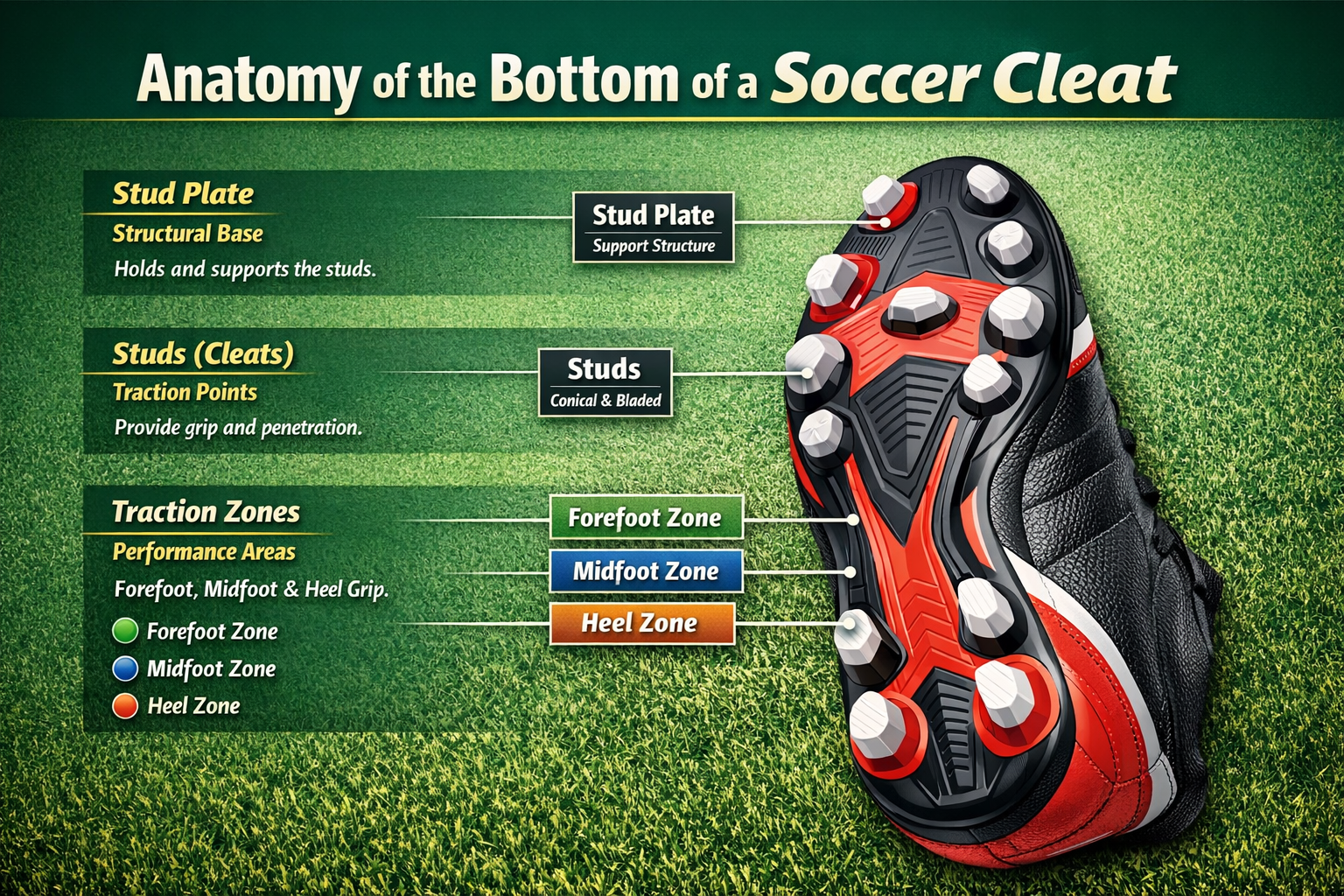
A soccer cleat outsole is made up of three core components:
- Stud plate: The rigid or semi-rigid base that supports the studs
- Studs (or cleats): The protrusions that grip or penetrate the surface
- Traction pattern: The specific layout, shape, and orientation of the studs
Understanding these terms allows you to evaluate cleats based on performance design rather than appearance—and helps you avoid mismatches that compromise safety.
Types of Soccer Cleat Outsoles by Playing Surface
Soccer cleat outsoles are not interchangeable. Each is engineered for a specific surface, and using the wrong type can reduce traction, accelerate wear, and significantly increase injury risk.
Firm Ground (FG) Soccer Cleats
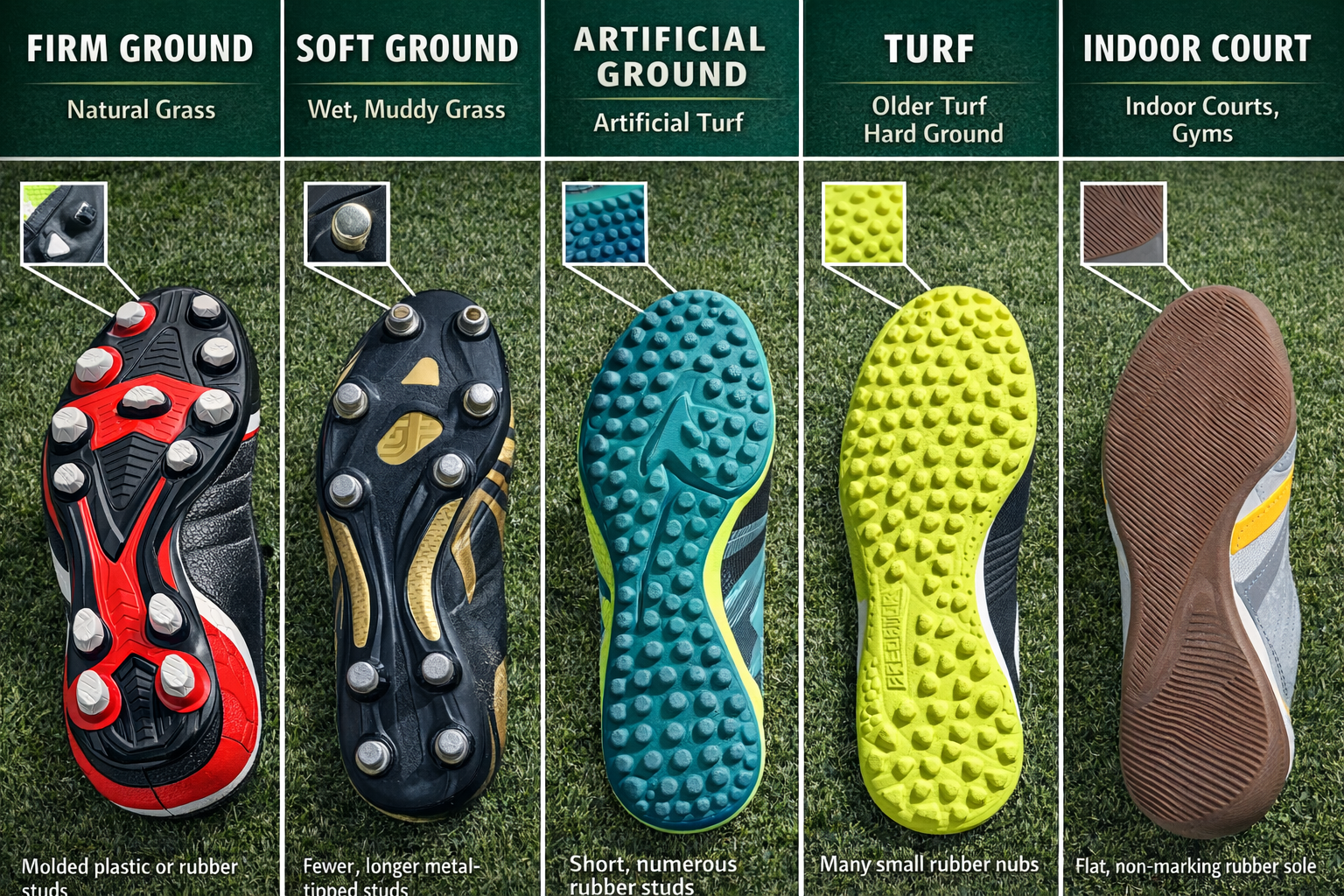
Firm ground cleats are designed for natural grass fields in dry to slightly damp conditions. The FG outsole typically uses molded plastic or rubber studs in a mix of conical and bladed shapes, usually totaling 10–14 studs per shoe.
Best for: Natural grass, outdoor matches, well-maintained training pitches
Performance characteristics: Balanced traction, even pressure distribution, moderate stud length (approximately 12–15mm)
Soft Ground (SG) Cleats
Soft ground cleats are built for wet, muddy, or heavily saturated natural grass. They feature fewer but longer studs—often 6–8 per cleat—frequently with metal tips. Many SG models use removable studs for customization.
Best for: Rainy match days, winter conditions, soft or loose grass
Performance characteristics: Deep penetration, exceptional grip in slick conditions, unsafe on firm or artificial surfaces
Artificial Ground (AG) Soccer Cleats
AG soccer cleats are specifically designed for modern third-generation artificial turf. They use shorter studs in much higher quantities—often 15 to 24 or more—to spread pressure evenly and reduce rotational stress.
Best for: Artificial turf, synthetic grass fields
Performance characteristics: Lower injury risk on turf, improved durability, optimized traction without excessive grip
Multi-Ground (MG) Soccer Cleats
Multi-ground cleats are designed to perform acceptably across several surfaces. They usually feature a hybrid stud pattern with more studs than traditional FG cleats and varied shapes for adaptability.
Best for: Recreational players, athletes training on multiple surfaces
Performance characteristics: Versatility over specialization, functional across conditions, not fully optimized for any single surface
Turf (TF) Soccer Shoes
Turf shoes replace traditional studs with dozens of small rubber nubs that cover the entire outsole. This design maximizes surface contact rather than penetration.
Best for: Older artificial turf, hard ground, training fields, street soccer
Performance characteristics: Minimal penetration, high durability, reduced traction on natural grass
Indoor Court (IN/IC) Soccer Shoes
Indoor soccer shoes feature flat, non-marking rubber outsoles with no studs at all. They are designed for smooth indoor surfaces where grip comes from friction, not penetration.
Best for: Futsal, indoor leagues, gym floors
Performance characteristics: Maximum contact area, quick directional changes, zero surface penetration
Soccer Cleat Stud Types and Configurations
Stud shape, material, and layout have a direct impact on traction, acceleration, and rotational freedom. These design choices influence how your foot interacts with the ground during movement.
Conical Studs
Conical studs are round and evenly shaped, allowing your foot to rotate naturally in all directions. This reduces resistance during pivots and helps protect the knees.
Advantages: Smooth rotation, reduced joint stress, reliable all-around traction
Best for: Midfielders, creative players, youth athletes
Bladed Studs
Bladed studs are elongated and angled to provide aggressive, directional grip. They excel during straight-line acceleration and hard stops but resist twisting motions.
Advantages: Explosive push-off, strong braking power
Disadvantages: Increased rotational torque, higher injury risk
Best for: Strikers and wingers focused on speed and sprinting
Chevron and Mixed Patterns
Many modern cleats combine conical and bladed studs in chevron or hybrid layouts. These patterns aim to balance acceleration, control, and rotational safety.
Performance benefits: Multi-directional traction, reduced injury risk compared to full-blade designs, position-specific optimization
How Stud Pattern Affects Performance by Position
Stud placement across the outsole is not random—it’s engineered to support the movement demands of different positions.
Defenders
Defenders benefit from stability-focused outsoles with higher stud density in the heel and midfoot. This supports backward movement, lateral shuffling, and strong planted stances.
Midfielders
Midfielders require versatility. Conical-dominant patterns with selective blade placement allow for constant turning, scanning, and short bursts of acceleration.
Forwards and Wingers
Attacking players gain an edge from forefoot-loaded stud patterns that emphasize explosive push-off. Bladed or aggressive mixed configurations enhance sprinting and quick takeoffs.
Turf vs Grass Cleats: Understanding the Critical Differences
One of the most common—and dangerous—mistakes in soccer equipment selection is using firm ground cleats on artificial turf.
Why FG Cleats Are Dangerous on Turf
Artificial turf does not compress like natural grass. FG studs, designed to penetrate soil, instead grip the surface too aggressively, creating excessive rotational resistance. This dramatically increases the risk of ACL and ankle injuries.
AG vs FG Cleats: The Technical Difference
AG cleats use shorter, more numerous studs to distribute force evenly across the foot. This reduces the “catch-and-release” effect that strains ligaments and causes joint fatigue.
Turf Shoes vs Cleats for Soccer
Turf shoes eliminate penetration altogether, making them ideal for hard or older turf surfaces. However, on modern artificial fields, AG cleats provide better responsiveness and traction.
Selecting the Right Soccer Cleat Bottom for Your Needs
Use this step-by-step approach to choose the correct outsole:
Step 1: Identify your primary playing surface
Step 2: Consider typical field conditions
Step 3: Match the outsole to your playing style and position
Step 4: Account for competition level
Step 5: Invest in multiple pairs if you regularly play on different surfaces
Common Mistakes to Avoid
Using FG cleats on artificial turf: Increases injury risk and accelerates outsole damage
Choosing cleats based on looks: Aesthetics don’t improve traction or safety
Ignoring stud wear: Worn studs reduce grip and increase slipping
Overly aggressive studs for youth players: Increases injury risk during development
Assuming one cleat works everywhere: Surface-specific designs matter
Maintaining Your Soccer Cleat Outsoles
Proper care extends cleat lifespan and preserves traction:
- Clean mud and debris immediately after use
- Monitor stud wear and replace when height is reduced by ~30%
- Avoid walking on concrete or asphalt
- Store cleats in a ventilated, cool environment
- Inspect the stud plate for cracks or separation
Frequently Asked Questions
The bottom of a soccer cleat is called the outsole. It includes the stud plate, studs, and traction pattern.
Conical, bladed, and mixed stud patterns are the most common.
Bladed studs enhance straight-line speed but resist rotation. Conical studs allow smoother pivots and reduce joint stress.
FG: 10–14, SG: 6–8, AG: 15–24+, turf shoes: 30+ nubs.
No. FG cleats significantly increase injury risk on artificial turf.
They maximize friction on smooth surfaces without damaging indoor courts.
Conclusion
The bottom of a soccer cleat is not just a traction surface—it’s a carefully engineered system that influences performance, comfort, and injury risk. Choosing the right outsole transforms how you move on the pitch and protects your body over the long term.
If you play on natural grass, invest in quality FG cleats suited to your position. If you play on artificial turf, AG cleats are essential—not optional. And if you regularly switch surfaces, owning multiple pairs is far better than relying on a single compromise option.
Take a moment to examine your current cleats. Look at the studs, identify the outsole type, and honestly assess whether it matches where you play most. That simple check often explains traction problems, fatigue, or recurring minor injuries.
Your feet are your most valuable tools in soccer. Give them the right foundation.



 By
By